The three come up in the same conversation and get treated as alternatives. They are not.
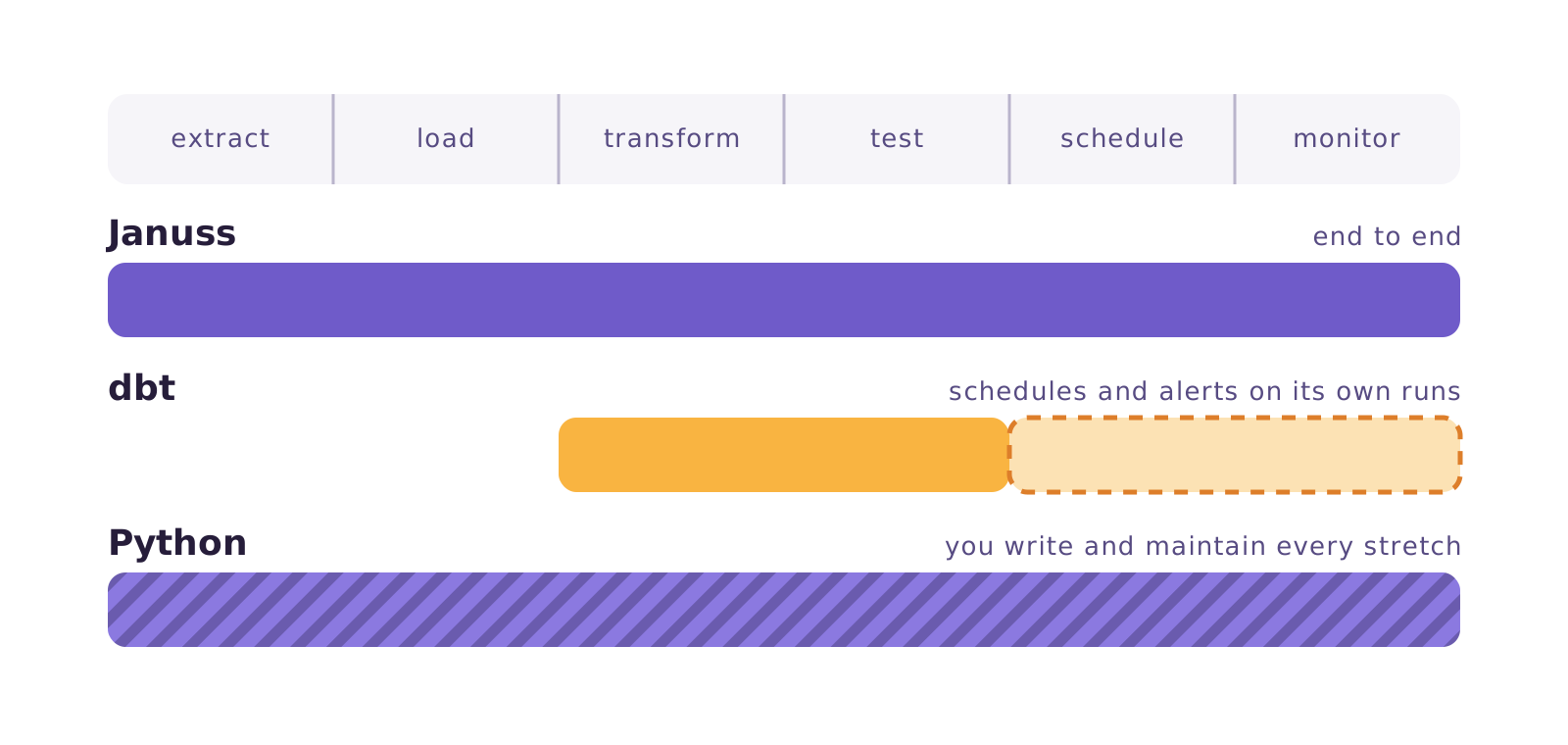
The data path has six stretches: extract from the source, load into the destination, transform, test, schedule and monitor. Each of the three options covers a different length of that path, and the difference does not show up in a feature list.
The problem is that comparing by feature produces a confusing tie, because they sit in different places along the chain. Comparing by stretch covered leads to the question that decides it: what is left for your team to build and maintain?
In this article we walk the six stretches with all three — including what Januss does not do and dbt does well, and what changed once dbt Labs and Fivetran became one company.
The stretch that decides: who moves the data
Start at the beginning of the path, because it sets the size of everything else.
In Januss, moving the data in is a screen. For an API, the AI writes the connector from the OpenAPI spec or from the documentation you paste in. It works out authentication and pagination, and the connector is only saved after a real call that read the data.
For databases, the reading comes from the transaction log on PostgreSQL, MySQL, SQL Server, Oracle and MongoDB. That is what brings incremental loads along, and it is also what makes deletions visible. Reading the log shows the row being deleted; querying the table on a schedule only shows that it is gone.
In Python, each of those items is your decision. Refreshing the token that expired mid-run, following that API’s pagination rule, respecting the rate limit, keeping track of how far you read, retrying on failure.
And dbt does not extract anything. It works on data that is already in the destination. This is not a criticism: it is the design of the tool, stated by the people who built it. But it has a practical consequence that gets lost in comparisons — dbt’s answer is never the whole chain, and something else puts the data there.
That is why this stretch decides the rest.
The six stretches, side by side
The table compares how each one is designed, stretch by stretch. It scores nobody: it describes how each tool was built, and that is what makes the choice possible.
Three rows carry most of the decision. The first and the second, because they separate who moves the data from who only works with it once it has been moved. The fourth, because it settles whether failing data reaches the destination at all.
The last two rows point the other way, and it is good that they stay visible: dbt versions and documents the transformation, and Januss does neither. A team that works with a repository will weigh that, and should.
| Januss | dbt | Python | |
|---|---|---|---|
| Extract from the source | API connector written by the AI and validated with a real call; log reading on five databases | Outside the design: works on data that already arrived | You write it, from authentication to pagination |
| Load into the destination | Eleven destinations, with the sync mode chosen per table | Outside the design | You write it, and maintain it |
| Transform | SQL running inside the destination database, with dependencies between steps | Version-controlled SQL models, with macros and ready-made packages | SQL or pandas, bounded by the memory of the process |
| When a test fails | Can stop the run before writing and block whatever comes next | Flags it on the already-built table, with warn or error severity | Whatever you wrote |
| Schedule | Comes with it: eleven frequencies from 5 min to 24 h, plus cron | The dbt platform schedules; dbt Core needs an orchestrator | You configure it outside the script |
| Monitor and alert | Email on failure and on recovery, and auto-shutdown after three failures in a row | Email, Slack and Microsoft Teams on run outcome | You write it |
| Version the transformation | Does not version it: the SQL is edited and run on the platform | Repository, review and continuous integration are the design | Repository, if the team already works that way |
| Document the model | Does not generate documentation from the code | Generates it from the code itself | You write it |
| Asks of the team | SQL | SQL and software engineering practice | Python, infrastructure and someone on call |
The rows describe how each tool is designed, not a quality score. dbt’s public material was consulted on 26 August 2026.
What dbt does with the transformation
dbt brought to data transformation the discipline software development already had. Every model is a SQL file, version-controlled, reviewed before it lands, tested on every change and documented from the code itself.
For a team with that practice, it is hard to beat. Incremental models, macros that avoid repetition, a large package ecosystem, and a scheduler of its own on the platform, with deploy, continuous integration and merge jobs.
Januss is not a development environment for transformations. The SQL is written and run on the platform: there is no repository, no review before a change lands and no documentation generated from the code. A team that already works that way will miss all three.
The open part stays open, which matters to anyone wary of depending on one vendor: the Fusion engine was released under an Apache 2.0 licence, as dbt Core v2.0. Whoever runs dbt Core keeps what they had, and pays for the platform only if they want the scheduler and the rest.
What dbt assumes is a cost too. Repository, review and automated testing are practice, not installation. A two-person team that never worked that way adopts the tool without adopting the practice, and ends up with the complexity and none of the benefit.
A tool installs in an afternoon. A practice does not.
Python covers everything, and you maintain everything
With Python you do all six stretches. Extract, load, transform, test, schedule and monitor, with no missing connector and no subscription.
What you build is also everything you have to maintain.
Authentication that expires, results split into pages, rate limits, tracking what was already read, retrying on failure, alerting when it did not run. Each of those is code somebody wrote once and somebody will debug at seven in the morning.
And the bigger cost is not the time, it is the concentration. When the knowledge of how the data arrives sits in one person’s head, the company carries a risk that shows up on no spreadsheet.
There is one exception worth stating, because it is real. Sometimes the extraction logic is genuinely unusual: an old protocol, a file in a format of its own, a business rule in the middle of the read. In those cases the script is the right answer, and no platform will cover it better.
For one stable integration, with someone who knows the language, the script is a fair call. For fifteen, it is a system nobody decided to build.
dbt and Fivetran under one company
On 1 June 2026, the merger between dbt Labs and Fivetran closed. They have been one company since, with both products still sold and run separately, and joint launches announced.
For anyone comparing tools, that changes less than it seems — and it confirms the point this article opened with. Transforming and moving are still two pieces, with two setups and two places to look when the number comes out wrong on Monday. What changed is that both pieces can now come from the same house.
There is a practical effect worth watching. When two pieces start being sold by the same company, the integration between them tends to improve and the contract tends to become one. None of that changes the number of setups somebody has to keep standing.
For a small team, the question is not whose the pieces are. It is how many it will sustain.
What happens when the data comes in wrong
This is where the three separate the most, and the part a feature comparison shows the least.
In Januss, the test runs during the load. An empty required field, a duplicate key, a broken relationship, a value outside a list: each test can either record a warning or stop the run and block the steps that follow. The data that fails does not reach the destination.
In dbt, the test is a query over the already-built model, with warn or error severity. It flags the problem after the table exists — and it is excellent at that, with history and documentation of what failed.
In Python, what happens is what you wrote. If nobody wrote it, the data goes in.
The difference is not one of rigour, it is one of timing. Testing afterwards gives a better record of what failed and why. Testing first stops anyone from making a decision on the wrong number between the load and the fix — and that window usually lasts a whole morning.
A concrete example
The source starts sending the discount as text with a decimal comma, and the conversion returns zero on every row that has cents. With the test during the load, the run stops and the dashboard keeps yesterday’s number, which is correct. With the test afterwards, the dashboard refreshes with the wrong number. The alert arrives alongside it, with the number already on the screen of whoever asked for the report.
Three different answers, and the difference shows up on the dashboard.
How to decide
Who is going to maintain the extraction? It is the stretch dbt does not cover and the one that eats the most time in Python. If the answer is "me, in my spare time", it decides on its own.
Does your team work with a repository and code review? If it does, dbt is worth the cost of adoption and does transformation better than Januss does. If it does not, adopting dbt brings the complexity without the benefit.
How many pieces do you want to keep standing? Each extra one is another place to configure, watch and investigate when the number comes out wrong.
Can wrong data reach the destination? If the answer is no, the test has to run before the write, not after it.
There is no right combination in the abstract. There is the one that matches the team you have today.
Where Januss comes in
Januss was built for the team that knows SQL, answers for the number and does not have — and does not want — a data engineering practice to sustain.
Extraction with an AI-written connector and log reading. Loading into eleven destinations, with the sync mode chosen per table. Transformation in SQL inside the destination, with tests that stop the load before wrong data arrives. Scheduling, email alerts and automatic shutdown after three failures in a row.
That is the six stretches in one setup. What changes the maths for a small team is not the price of each piece: it is the number of pieces somebody has to understand to answer why Monday’s number looks different.
If your team already version-controls models and runs automated tests on every change, dbt still does transformation better. And if you have one stable integration and know Python well, the script is still defensible.
The expensive spot is the middle: fifteen scripts nobody decided to build, or an engineering practice adopted halfway.
Want to see the whole chain with a source of your own? The 14-day trial does not ask for a card: create your workspace.
Create your workspace in minutes.
Point at your source and watch the data reach the database the same day.