Comparing integration platforms by connector count is the fastest way to choose wrong.
The catalogue matters on day one. After that, what matters is what reaches the destination, under which guarantee, and what happens when the number is wrong at seven in the morning.
Januss and Dataddo both move data from many sources into databases and analytical stores. Both capture changes, both run inside the customer network when the data cannot leave, both transform before delivering. At that level, they tie.
In this article we compare the two by what they hold up after the load, always from Dataddo's public material. Five axes: the guarantee on the destination table, the tests that run before the number reaches the dashboard, how regional formats are handled, the unit that triggers billing and where credentials are kept.
What the destination table guarantees
Start here, because this is the axis that survives the first month. Once the connectors are up, the question that comes back every week is a different one: what does this table guarantee?
The sync mode is chosen per table. Full refresh, incremental, mirroring or versioned history, with start and end validity dates. The order status table wants history. The product reference table wants mirroring. Deciding that once per table is not the same as deciding it once for the whole pipeline.
The incremental mode carries a stated guarantee. On every run, the destination table ends up identical, row by row, to what a full reload would produce. It reprocesses the scope that changed and deletes what disappeared from the source — which is where a plain upsert leaves debris behind.
When the guarantee cannot be met, the engine refuses and says why. A transformation that aggregates over a join makes it impossible to isolate the scope of what changed. Instead of delivering an approximate number nobody will check, Januss reconciles the whole step and records the reason.
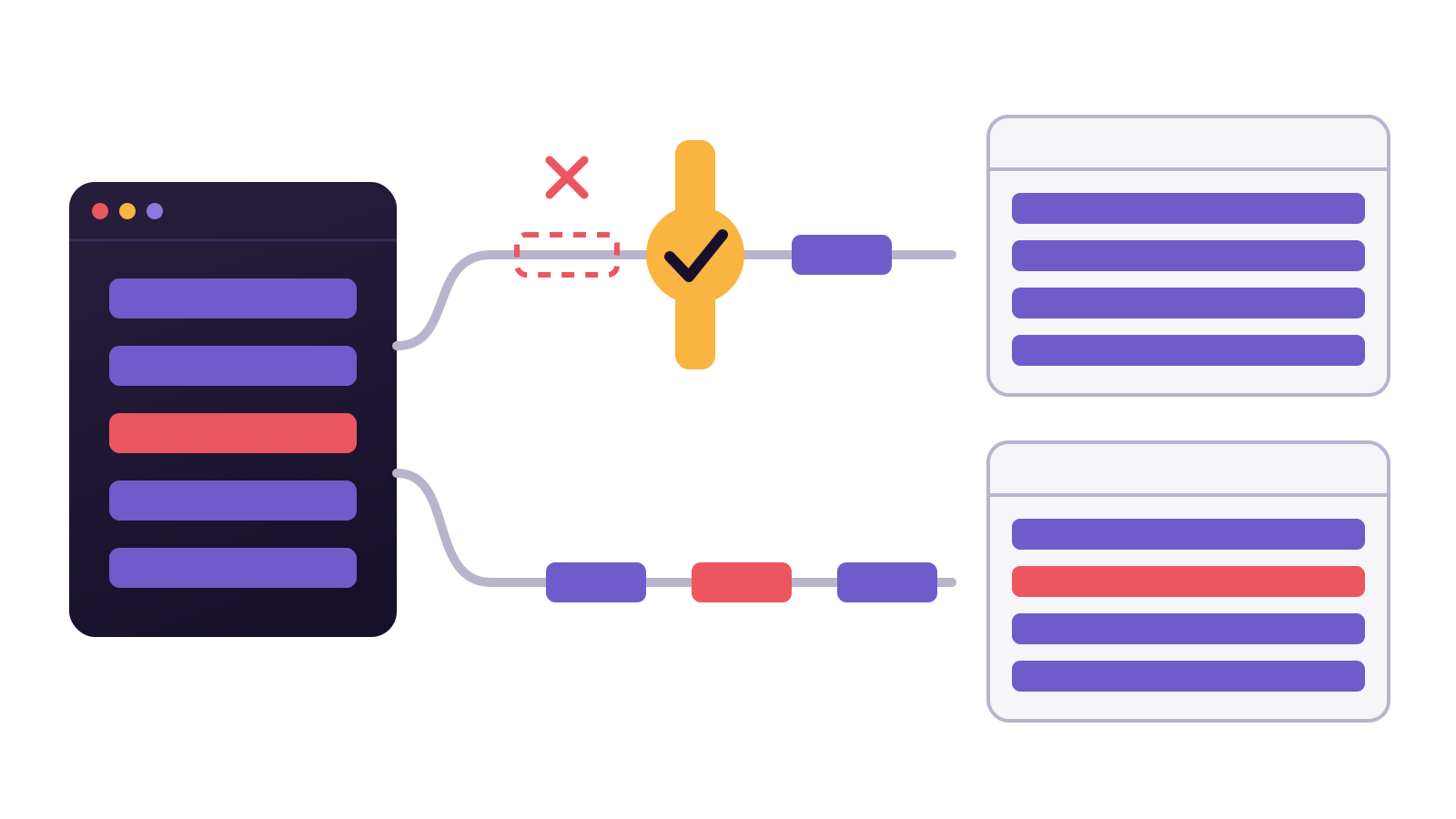
Then come the tests, declared inside the step itself. A required field that arrived empty, a unique key that got duplicated, a value outside the accepted list, a broken relationship between two tables, or a SQL query of your own. Each test carries its own severity — stop the run, or only warn.
Stopping has a consequence worth spelling out: the dashboard keeps showing yesterday's number, which is right, instead of showing the new one, which is wrong.
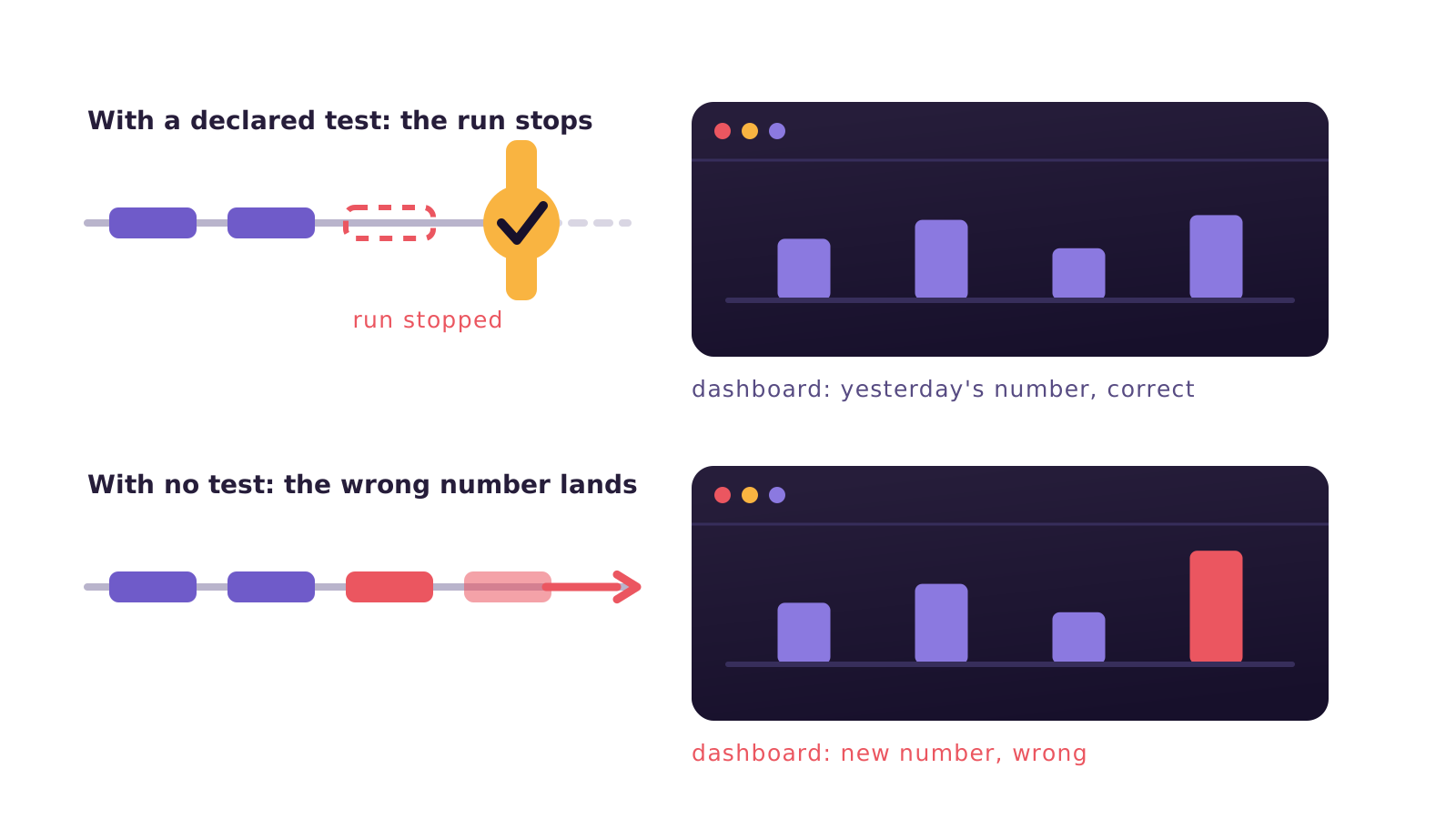
Dataddo has a documented check of its own: the Data Quality Watcher applies column-level rules for null values, zero values and anomalies. The difference is what happens next. Their documentation says that when the data does not meet the rule “the data transfer will proceed, but the user will receive an email notification detailing the error and the affected column”.
Those are two architectural decisions. One holds the data at the door; the other lets it through and tells you. Which one you want depends on who looks at the dashboard first in the morning.
The two, side by side
Before going line by line, the whole picture:
| Januss | Dataddo | |
|---|---|---|
| Incremental guarantee | On every run, the destination table ends up identical, row by row, to what a full reload would produce | not stated |
| Sync mode | Four, chosen per table: full refresh, incremental, mirroring and versioned history with validity dates | Full replication and capture methods, combinable per table |
| Quality tests | Five types declared inside the step, with severity: stop the run or only warn | Data Quality Watcher: column-level rules for nulls, zeros and anomalies — the transfer proceeds and the user is emailed |
| Handling during the load | Thirteen conversion rules chained per column, with eight regional formats | regional format not stated — there is a transformation pipeline with type conversion expressions |
| Sources | Five databases, MongoDB, spreadsheets and files — plus any REST API you point at | More than four hundred ready-made connectors, maintained by their own team |
| Source outside the catalogue | Connector written by AI from the documentation, validated by a real call before saving | Their team builds it: around ten business days on one page of the material, four weeks on another |
| Change capture | Transaction log on PostgreSQL, MySQL, SQL Server, Oracle and MongoDB, on every plan | method per database not stated — several methods, combinable per table |
| Billing unit | Row written to the destination, adding up every step that writes | Flow: one connection between a source and a destination, regardless of volume |
| When volume overshoots | Overage charged per million, with an invoice cap per plan | cap not stated — entry plans carry a monthly row limit |
| Currency and invoicing | Brazilian reais, with a Brazilian invoice | US dollars |
Where Dataddo shows up as not stated, that is what its public material does not cover — not a claim that the feature does not exist.
The sections below open each row.
Who writes the connector that is missing
Januss has no application catalogue, and solves the problem from the other end. You point at the OpenAPI specification the API publishes, or paste the written documentation, and the AI builds the connector and the table catalogue. It works out how the API asks for authentication, among six supported schemes, and how the result is split into pages.
Two things separate that from an ordinary generator.
The configuration is not accepted without verification. Before saving, Januss makes a real call to the API and checks that it could read the data that came back. A connector that looks ready and breaks on the first production run is worse than an error on the configuration screen.
The AI writes the connector once. After that the extraction always runs the same way, with no AI in the data path. That matters for reproducibility and for auditing, and it is a question worth asking any vendor that advertises AI in the product.
Dataddo starts from the opposite decision, and it is worth saying plainly: their catalogue is large. More than four hundred connectors maintained by their own team, covering marketing applications, databases and enterprise systems. When the connector does not exist, they build it — their public material says around ten business days on one page and a four-week window on another.
The practical difference is not having or not having a connector. It is who waits for it, and for how long. That weighs at two moments. First, when you are evaluating the tool and want to test it against your internal API before signing. Second, when the source is so specific that nobody else will ever ask for it.
A concrete example
A manufacturer needs to move data from a shop-floor reporting system, built to order by a local consultancy, into the efficiency dashboard. No catalogue anywhere has a connector for it, and none ever will. On one side, that is a request and a development queue. On the other, it is the system documentation and the configuration screen.
Regional formats handled during the load
What comes back from a Brazilian API is rarely ready to be written. It arrives as "1.234,56" in text, "19/08/2026" in the local date order, "S" and "N" where a boolean was expected.
Januss handles that during the load itself. Thirteen conversion rules you chain per column — currency, date, number, text, regular expression, value map — with eight regional formats. And you decide, column by column, what happens to a value that fails to convert: fail the run or write it empty.
It is an explicit choice on screen, not a behaviour you discover in next month’s report.
A tool born in the US market treats the local format as an exception. Where the data comes from, it is the common case.
Dataddo has a transformation pipeline with expressions — type conversion, dates from text, string operations. Regional formats and a per-column error policy are not stated in the public material. If that is your case, it is the kind of item worth seeing work in a demo, with your own data.
Change capture: what is documented
Both capture changes, so the generic argument separates nothing. What separates them is what is written down.
In Januss, the read is from the transaction log of five named databases: PostgreSQL, MySQL, SQL Server, Oracle and MongoDB. It is available on every plan, including the entry one. The platform checks the database prerequisites before letting you save the connection, and the message carries the command that fixes it — including the Amazon RDS variant when the instance is managed.
Dataddo advertises full replication and several capture methods, combinable on a per-table basis, and mentions a dedicated binary log connector. The public material does not say which method applies to which database, or from which plan onwards.
That does not mean the reach is smaller. It means the question has to be asked during the evaluation: is it log reading or scheduled querying, on which database, and on which plan?
The billing unit and the invoice cap
Januss charges per row written to the destination, adding up every step that writes. The model carries three protections worth more than the list price:
- An invoice cap per plan. Overage is charged per additional million up to a limit the account never crosses, always lower than the next plan’s monthly fee.
- A warning before you overshoot. Usage shows on screen in real time, with alerts at 80% and 100% of the allowance, instead of showing up on the invoice.
- A transformation materialised as a view does not consume the allowance. An intermediate layer that does not need to be written costs nothing — which changes the bill for anyone who models in several steps.
Dataddo charges per flow: one connection between a source and a destination. The price does not vary with the volume going through it. Entry plans do carry a monthly row limit and a lower load frequency, so volume independence pays off from a certain level up.
The two models are predictable in opposite ways. In the per-flow model, the axis is the number of connections: a new source costs a whole flow, even when it is a small lookup table. In the volume model, the axis is how much was written: a new source costs nothing just for existing.
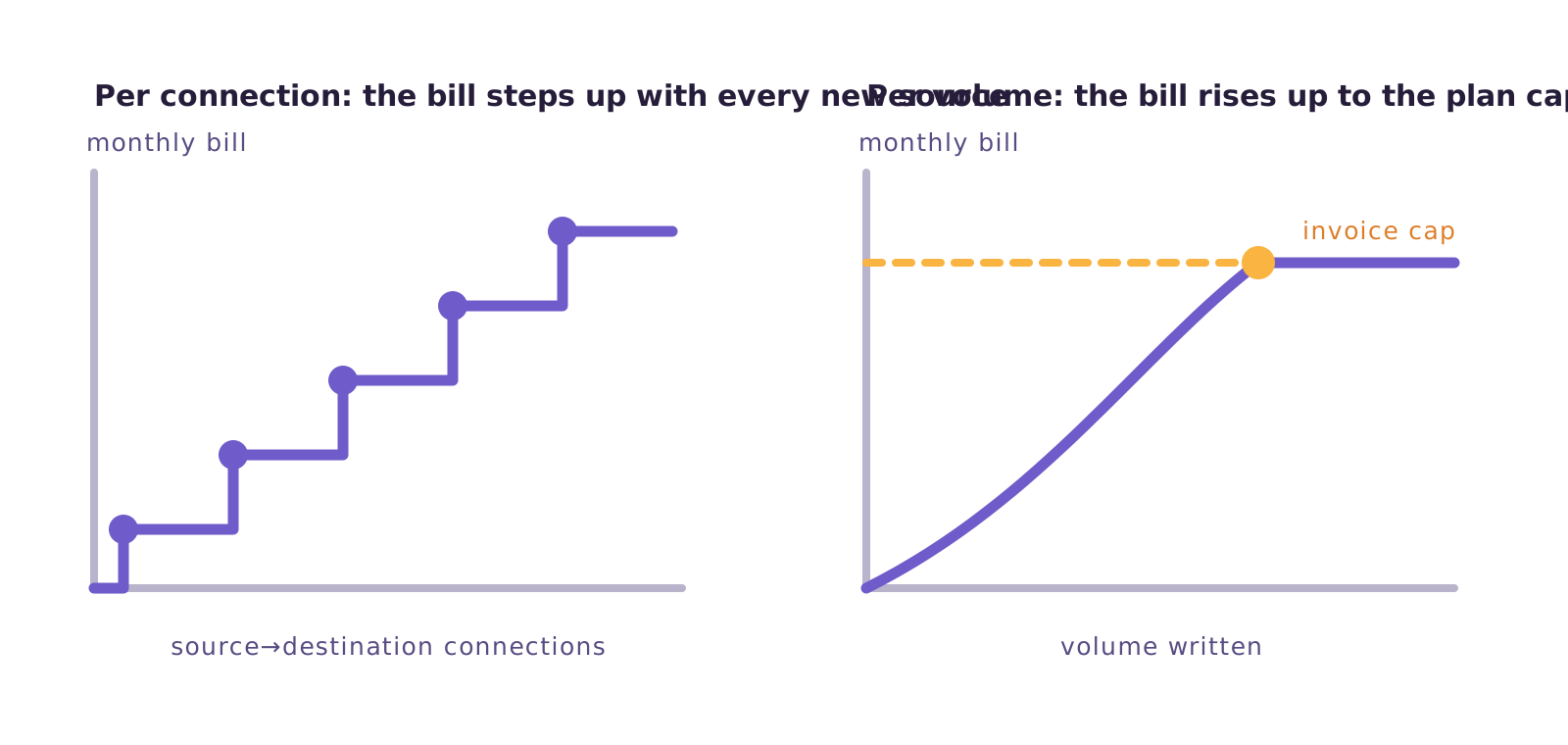
The question that settles it is short. Do you have many small sources or a few large ones?
And there is the part that appears on no pricing page. Dataddo charges in dollars, which means exchange rate inside the annual budget, tax on a service contracted abroad and foreign tax documents in the finance queue. Januss charges in Brazilian reais, with a Brazilian invoice. That is not a product argument. It is an operations argument, and in many companies it settles the matter before any technical discussion.
Where the credentials are kept
The password to your production database is the most sensitive asset in any integration, and almost no comparison talks about it.
In Januss, credentials are encrypted in your browser, before they leave your machine. The platform stores the encrypted package and never opens it: the executor does, at the moment of the run. There is an SSH tunnel for databases that are not exposed, and execution happens in the region the account picks, Brazil or the United States.
When the data cannot leave the network, the Runner is installed inside your infrastructure and talks to the platform over a single outbound connection on port 443. No inbound firewall rule, and nothing changed on your network.
Dataddo has an equivalent model for that second part: the public material describes the data plane running in the cloud, on your own infrastructure or both, when residency requirements demand it. It also states compliance with the Brazilian data protection law. How credentials are stored is not covered.
How to decide
Four questions settle most cases:
- Are your sources in a catalogue? If all of them are, the larger catalogue wins comfortably. If any is outside it, the question becomes who writes that connector and when it will be ready.
- Do you need a guarantee or a delivery? If the data just has to arrive, both deliver. If the number has to be right before it shows on the dashboard, ask both what happens when a record comes in inconsistent.
- Many small sources or a few large ones? Many small ones favour per-connection billing. A few large ones favour volume billing with a cap.
- Is your data local and does your company pay in local currency? Currency, dates, text formats and invoicing. Added up, those four usually weigh more than any single feature.
None of the four has a right answer in the abstract. All of them have yours.
Where Januss comes in
Januss was built for the team that answers for the number, not only for the load.
An API connector written by AI from the documentation and validated by a real call before saving. Four sync modes chosen per table, with a stated guarantee on the incremental one and an explicit refusal when it cannot be met. Five types of test that stop the run before the wrong number reaches the dashboard. Thirteen conversion rules per column, with eight regional formats. Transaction log reading on five databases, from the entry plan onwards. Credentials encrypted in your browser. And an invoice cap in the contract.
If that is your scenario, the list above is not a brochure: it is the product.
Want to compare it against your real case? It is a 14-day trial, no credit card: create your workspace.
Create your workspace in minutes.
Point at your source and watch the data reach the database the same day.