Most comparisons on this blog open with the same argument: an off-catalogue source is solved by building the connector from the API documentation.
Against Airbyte, that argument does not hold. Its connector builder has an assistant that reads the documentation URL or the API spec and fills in base URL, authentication, pagination and the available streams. It is the same design.
Except that the comparison does not end there. It has to happen somewhere else, and it does, in three places: what each one does after the data lands, who operates the platform, and the unit each one bills by.
In this article we walk through all three, always from Airbyte’s public material, and we finish with the scenarios where it is the right answer — and there are several.
What happens after the data lands
Start at the end of the path, because that is where the two designs part ways.
In Januss, the load does not end at the write. The transformation is SQL running inside the destination database, with dependencies between steps and reprocessing limited to the scope that changed. Declared tests run alongside it: an empty required field, a duplicate key, a value outside the accepted list, a broken relationship. Each test can either warn or stop the run.
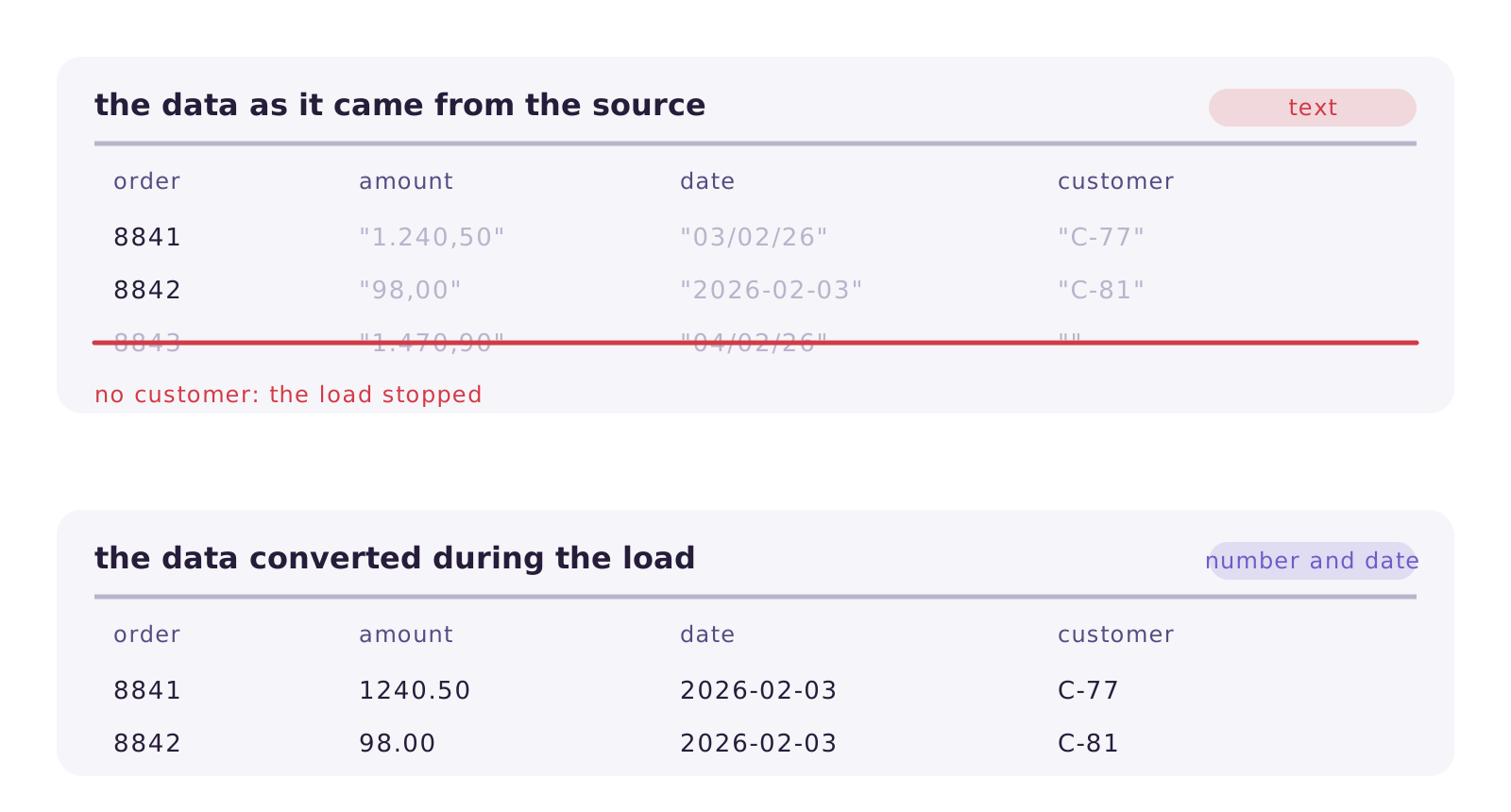
And regional format is settled during the load, not after it. Thirteen conversion rules you chain per column, with eight regional formats, and a per-column decision on what happens to a value that does not convert: stop the run or write null.
On databases, incidentally, both read the log. It is worth saying that up front, because it is where the easy argument would appear: Airbyte also does log-based change capture, with deletions marked in the destination. That is not an axis of difference between the two, and treating it as one would be choosing to be wrong.
Airbyte moves the data, and that is by design. The platform describes itself as ELT pipelines into the warehouse, and the normalisation it used to ship was discontinued. Data lands in the destination as it was at the source, and organising it is the next layer’s job.
For a team that already has that layer, the separation is clean and even preferable: each piece does one thing well. For a team of one or two people, it is the difference between one decision and three: choosing the tool that moves, choosing the one that transforms, and keeping the two talking.
A concrete example
A logistics company connects its tracking system in an afternoon, and two weeks later the data is in the warehouse. That is when the second half of the project starts. Values arrived as text with a decimal comma, dates in two formats, and nobody decided what to do with the record that arrives without a customer code. That part was not on the schedule.
Moving is the half that fits in the estimate.
The two designs, side by side
The table compares how each one is designed. It scores nobody: it describes how each tool was built, and that is what makes the choice possible.
The first three rows are the axis of this article. They say the same thing from three angles: what Airbyte delivers is the data moved, and what Januss delivers is the data moved, converted and checked. A team that already has the second half solved does not need it again.
The last three run the other way, and it is good that they stay visible. Airbyte’s catalogue is large, the development kits cover what no visual builder reaches, and SSO and RBAC exist on its Pro plan. Januss has none of that, and the roles row is the one most likely to decide on its own.
| Januss | Airbyte | |
|---|---|---|
| After the load | Transformation in SQL inside the destination, with dependencies between steps | outside the design — data lands as it was at the source |
| When the data comes in wrong | Declared tests per column, which can stop the run before writing | not stated — the guidance is an external tool |
| Regional formats | Thirteen conversion rules per column, with eight regional formats | not stated — the value lands as it came |
| Off-catalogue source | The AI writes the connector from the documentation, and it is only saved after a real call that read the data | The builder’s assistant reads the documentation and fills the connector in; in beta, with testing left to whoever builds it |
| Ready-made catalogue | No app catalogue: every API source is born from its own documentation | More than 600 connectors, plus the ones built by the community |
| Where it runs | Managed cloud, or a Runner on your network when the data cannot leave | You host it, or you use the company’s cloud service |
| Roles and corporate login | Not available: there are user invitations, with no roles and no corporate login | SSO and RBAC on the Pro plan |
| Extending for the odd case | SQL, and nothing beyond it | Development kits in several languages |
| Spend cap | Every plan has a cap the invoice does not pass, with consumption on screen in real time | not stated on the pricing page |
The coral X marks what Airbyte’s public material does not cover, or what it states to be outside its design — never a claim that the feature does not exist. Hover a cell to read the full sentence. Consulted on 27 August 2026.
The generated connector, on both sides
The tie is worth spelling out, because it is real and because what is left of the difference is small and concrete.
In both, you point at the API documentation — or at the spec — and the tool fills the connector in: base URL, authentication, pagination, available streams. Neither asks you to write the HTTP client by hand.
The difference is in what happens before saving. In Januss the connector is only saved after a real call that managed to read the data. After that it is deterministic: extraction runs the same way every time, with no AI in the path of the data.
On Airbyte, the assistant’s own documentation says it is in beta, recommends reviewing what was filled in, and leaves testing as a step you run. It is a difference of guarantee, not of capability.
Both get to the same place. One of them checks the road first.
And there is the case where nothing needs generating. When the source is already in Airbyte’s catalogue — more than six hundred connectors, plus the community-built ones — the first load is a choice from a list. Januss has no app catalogue: every API source is born from its own documentation, even for a well-known service.
For a popular source, the catalogue is faster. For the source nobody has connected yet, both do the same work.
Who operates the platform
Airbyte’s open plan costs no licence. It costs operation.
Server, version upgrades, monitoring, backups, and fixing the connector that stopped working after an update. For a team with infrastructure and people, it is manageable and worth it. For the BI analyst who already answers for the dashboard, it is a second job.
There is the company’s own cloud service, which solves the operation. The transformation layer and the tests stay outside it.
In Januss there is no server to operate, and version upgrades are not the user’s business. Scheduling comes with it, with eleven frequencies and cron, and email alerts on failure and on recovery. The dashboard lists the pipelines whose last run failed, with a link to the technical detail. After three failures in a row the pipeline shuts itself down, instead of running on quietly and burning through the allowance.
When the data cannot leave the network, the Runner installs with a single command and talks through one outbound connection on port 443, with no inbound firewall rule. It updates itself, and shared directories are always read-only: Januss changes nothing on the customer’s machine.
The cost of operating shows up slowly. It is not in the proposal; it is in the calendar of someone who already holds another job.
Zero licence is not zero cost.
How each one bills
Here Airbyte has an argument Januss does not, and it deserves to be said in full.
Its paid offering has two models: one plan billed by volume and another billed by capacity — dedicated processing units, rather than the data moved. The capacity model exists precisely because billing by volume squeezes anyone replicating databases, which is the case where volume is high by nature.
Januss bills per row written to the destination. Not for what was read to get there, and counting each step that writes. In exchange, every plan has an invoice cap, consumption shows on screen in real time, there are alerts at 80% and 100% of the allowance, and a transformation materialised as a view consumes nothing.
They are different models with different risks, and neither is better in the abstract. For replicating high-volume databases, capacity billing tends to come out ahead of per-row billing.
Two questions are worth asking any vendor during an evaluation: is there a spend cap, and what happens to the bill when a schema change at the source triggers a full reload? The second one usually reveals more than the price table.
Ask about the cap before you sign.
How to decide
Who does the transformation? If that layer is already settled on your team, with repository practice and review, Airbyte fits and Januss does not replace the tool you already use. If it is not settled, choosing Airbyte means choosing two tools.
Who operates the server? If the answer is "me, in my spare time", the open path costs more than it looks. If there is infrastructure and there are people, it is legitimate and cheap.
Do you need roles and corporate login? Januss has neither. If that is a requirement, the decision is already made, and it is in Airbyte’s favour.
Is your volume in databases or in APIs? High-volume database replication favours capacity billing. Many API sources with moderate volume favour per-row billing with a cap.
There is no right answer in the abstract. There is the one that matches the team and the volume you have today.
Where Januss comes in
Januss was built for the team that knows SQL, answers for the number and does not want to assemble a chain of three tools.
A connector written by the AI and validated with a real call. Transaction log reading on five databases, on every plan. Transformation in SQL inside the destination. Tests that stop the load before wrong data arrives. Thirteen conversion rules for regional formats. Billing per row written, with an invoice cap on every plan.
If you already have a transformation tool, if you need roles or corporate login, or if you want open source running on your own infrastructure, Airbyte covers what Januss does not. Saying that now costs less than a frustrated customer in the third month.
What decides it is not the connector, because on that front the two designs have converged. It is what happens to the data after it lands, and how many people it takes to keep that running.
Want to compare against your real scenario? The 14-day trial does not ask for a card: create your workspace.
Create your workspace in minutes.
Point at your source and watch the data reach the database the same day.